
The short answer
Individually, almost nothing. A common Pokémon card from the last fifteen years is worth somewhere between a fraction of a cent and about twenty cents, and it usually cannot be sold on its own at all.
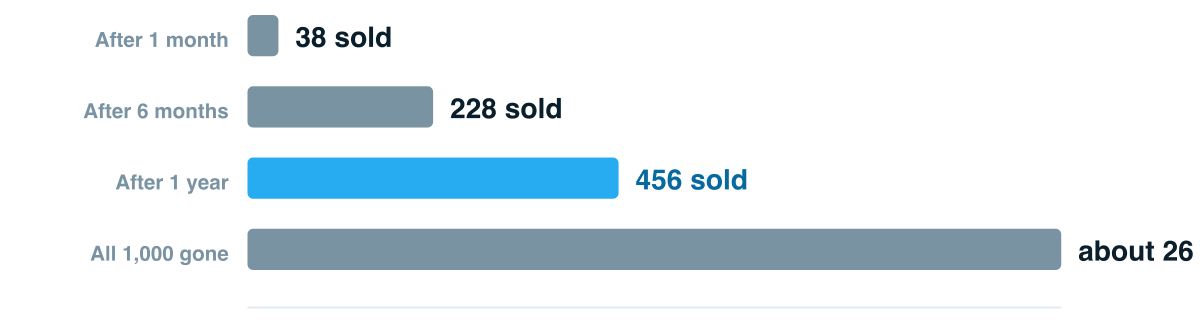
In bulk they are worth real money. Our last lot cost $0.08 a card, and a thousand of them produced $82.94 of sales in the first month. The unit is the box, not the card.
This is the question that decides whether someone spends a weekend sorting or twenty minutes packing a box. It deserves a straight answer.
Why a common is worth so little
Print runs are enormous. Modern sets are printed for years, and a common appears in a large share of packs opened worldwide, so the supply of any given common is measured in millions.
Demand for them is real but tiny. Someone building a specific deck needs four copies of one common, and they will buy them from whoever already has them listed at the lowest price.
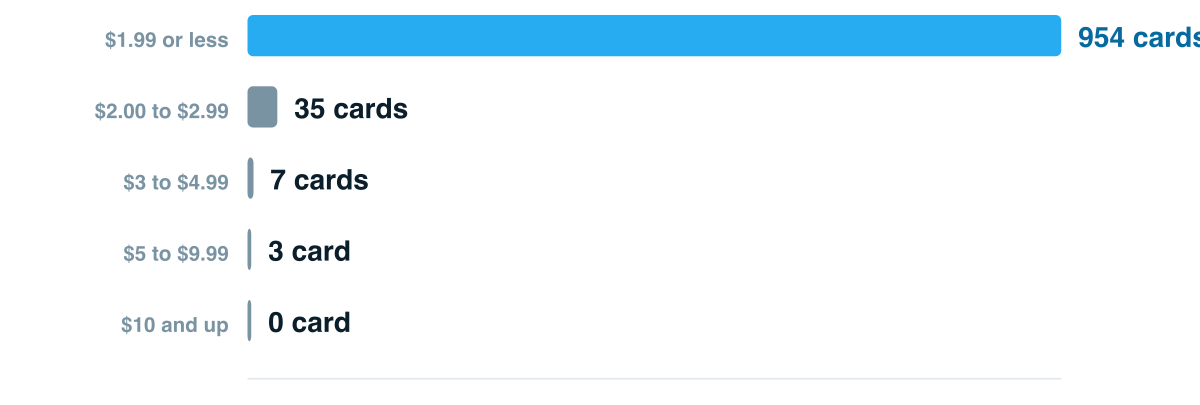
That is why our own pricing looks like this. Even after scanning and identifying every card, 97.5% of what we hold prices at the floor, and the floor exists because below about two dollars an individual listing does not pay for itself.
The costs that make a cheap card unsellable alone
Every order carries a fixed charge of $0.30 and a shipping label that averages $0.88. That is over a dollar before the card itself is worth anything.
So a card that would sell for 20 cents cannot be sold for 20 cents. It has to travel with other cards, or in a box of a thousand, or not at all. We measured every one of those charges.
How many commons is a normal collection
A childhood binder is usually 300 to 600 cards, of which perhaps thirty are holo. A collection built by an adult opening current sets runs into thousands, and the ratio of commons is higher because modern sets print more of them.
Either way the shape is the same: a small stack that is worth looking up and a large pile that is worth counting. Knowing which pile you are holding decides everything about how to sell it.
When a common is not really a common
Three exceptions worth checking before the box goes out the door. Pre 2003 commons in clean condition, where age and condition carry the price on their own. Commons that see competitive play, especially trainers, which get bought four at a time. And first edition prints, where the stamp matters more than the card.
Everything else is bulk, and there is nothing wrong with that. Our breakdown of what is inside a lot shows how the value distributes.
What to do with a pile of commons
Sell them as one lot, by count, to someone who buys volume. Sorting them by set first raises what a buyer will pay, because you are handing over hours they would otherwise spend, which is the same reason sorted bulk costs more than unsorted.
What does not work is listing them individually and waiting. At our sell through rate a thousand cards take about 34 months to clear, and that is with a full time process behind them.
Commons are not worthless. They are just worth something only in quantity, which is a different sentence.
Frequently asked questions
- Are common Pokémon cards worth anything?
Individually between a fraction of a cent and about 20 cents, and usually not sellable alone because fixed costs exceed the price. In bulk they are worth real money: we paid $0.08 a card and 1,000 cards produced $82.94 of sales in the first month.
- Why can't I sell a 20 cent card on eBay?
Every order carries a $0.30 fixed charge plus a shipping label averaging $0.88. That is over a dollar of fixed cost, so cheap cards have to be sold in bundles or in bulk.
- Which common cards are actually worth something?
Pre 2003 commons in clean condition, commons that see competitive play, and first edition prints. Everything else is bulk.
- What should I do with hundreds of common cards?
Sell them as one lot by count to a volume buyer. Sorting them by set first raises the price because you are saving the buyer hours of work.