
The short answer
Selling a collection card by card gets you the most money and costs the most time. At our own sell through rate, 1,000 cards take around 34 months to clear and each sale nets about $2.25 after fees.
Selling the whole lot at once gets you maybe half to three quarters of that, today, in one message. If your collection is mostly commons, selling it yourself is almost never worth the evenings.
This is the decision everyone hits after they finish sorting. Here is the same question answered with real numbers instead of encouragement.
What selling it yourself actually looks like
We list bulk singles full time with a document scanner and software built for it, and we still only move 2.9% of the catalogue per month. That is not a failure, it is what this inventory does.
Apply that to a thousand cards and you are looking at roughly 29 sales a month, for about 34 months, at $2.86 a sale before fees.
The per card economics
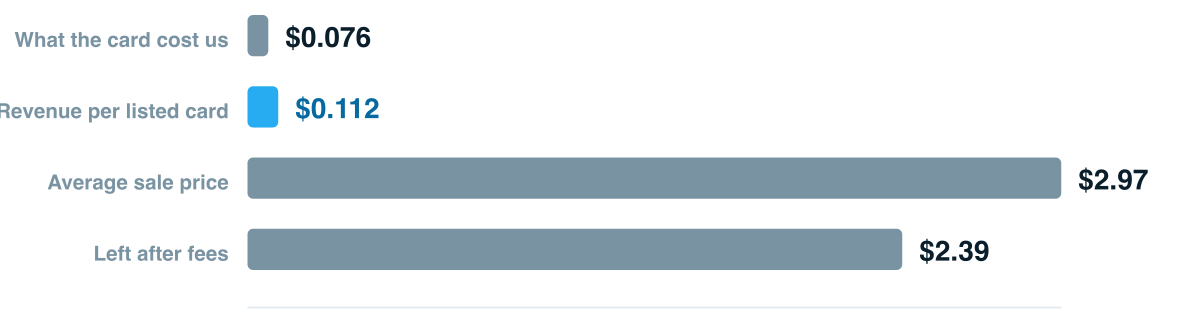
Out of an average $2.86 sale, eBay keeps 21.5% and the label costs $0.88. What lands is about $2.25 minus shipping, and you still have to buy sleeves, toploaders and envelopes.
Then there is the part no spreadsheet shows: photographing, describing and packing each card. A single sale is a trip to the mailbox for two dollars.
What the work actually is
Per card: photograph the front and the back, identify the exact set and number, write the condition honestly, price it against completed sales, then sleeve it, put it in a rigid holder and address an envelope.
Call it three or four minutes once you have a routine. On a thousand cards that is over fifty hours before a single trip to the post office, and the routine is the part that takes weeks to build.
Then there is the tail. Returns, cards that arrive bent, buyers who never pay, and the listings that sit for a year because nobody searches for that Pokémon.
The honest comparison
| Sell it yourself | Sell the whole lot | |
|---|---|---|
| Money | Highest, in theory | 50% to 75% for real cards, cents per card for bulk |
| When you get it | Spread over ~34 months | Now |
| Your time | Hours per week, indefinitely | One message and a box |
| Risk | Returns, damage, cards that never sell | None once it is sold |
| Worth it when | You have graded or vintage cards | You have volume and commons |
The line is not about how much your cards are worth. It is about how many of them there are. Twenty good cards are worth listing yourself. Four thousand commons are a second job.
The middle route almost nobody takes
Split the collection. List the ten or twenty cards that are clearly worth more than $10 yourself, and sell the rest as one lot.
You keep most of the value, because value concentrates in a handful of cards, and you skip the three years of mailing two dollar envelopes. This is what we would do with our own childhood box, and we do this for a living.
To find those ten cards, start with what your old cards are worth. To check the offer on the rest, read how to tell whether an offer is fair, and if you want the full mechanics of doing it yourself, that is what our seller playbook is for.
Whatever you choose, choose it knowing the clock. Most people quit halfway and end up selling the remainder anyway, after the effort and without the cash.
Frequently asked questions
- Is it better to sell Pokémon cards individually or as a lot?
Individually pays more per card but takes far longer. At our sell through rate of 2.9% per month, a thousand cards take around 34 months to clear. A lot sale pays less and finishes today. Volume decides it, not value.
- How long does it take to sell a Pokémon collection on eBay?
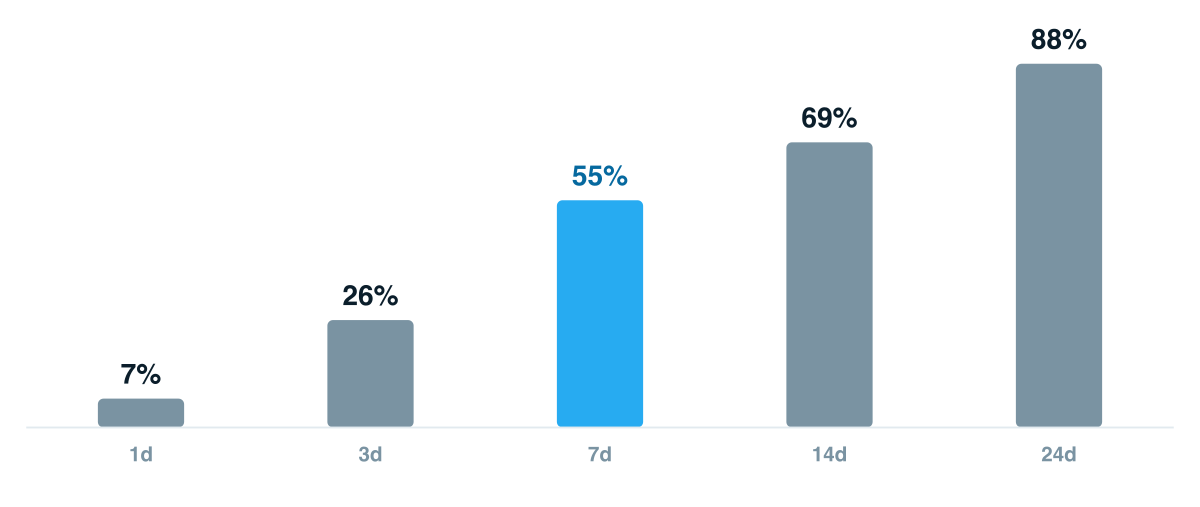
In our store 29 out of every 1,000 listed cards sell per month, so a thousand card collection takes roughly 34 months card by card. Individual cards that do sell go fast: the median was 5.2 days.
- How much do you actually keep per card on eBay?
Our average sale was $2.86, of which about $2.25 remained after fees, before the shipping label of $0.88 and supplies.
- What is the best approach for a mixed collection?
Split it. List the ten or twenty cards clearly worth more than $10 yourself and sell the rest as a single lot. Value concentrates in a few cards, so you keep most of it without years of mailing envelopes.