
The short answer
For a collection with real cards in it, offers usually land between 50% and 75% of market value. Below 40% is low unless the collection is entirely bulk. Above 80% is rare, and usually means the buyer only wants the three cards they already spotted.
For unsorted bulk there is no percentage at all. It is priced per card, roughly 1 to 10 cents, because nobody knows what is in it until someone spends hours finding out.
We buy collections, so treat this as a page written by the other side of the table. That is exactly why it is useful: here is the arithmetic a buyer is doing while they look at your cards.
Why nobody pays 100%
Say your cards are worth $1,000 on TCGplayer. A buyer who pays you $1,000 makes nothing, so the question is what happens to that $1,000 on its way through them.
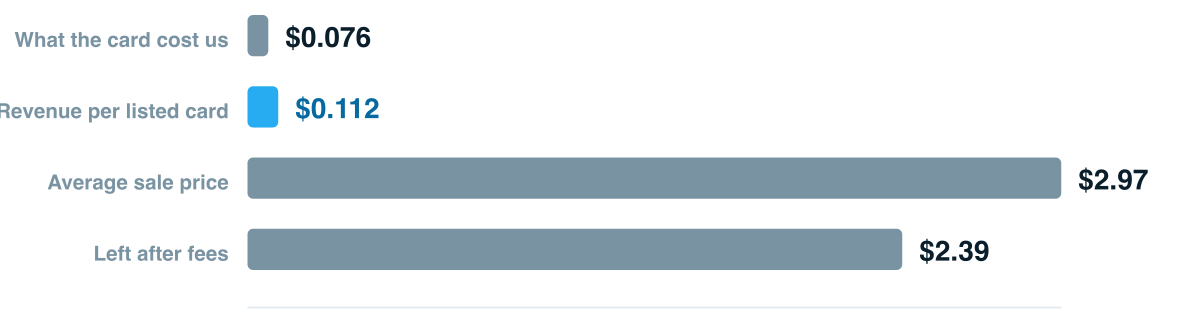
Fees take 21.5%. That is measured on our own settled sales, not the advertised rate. eBay charges 13.25% plus $0.30 per order, and on cheap cards that fixed charge is most of it. We broke that down sale by sale.
Shipping takes another chunk. Our average label costs $0.88, which against an average sale of $2.86 is about 30.8% of the money. On a $30 card that is noise. On a $2 card it is huge, and most cards are $2 cards.
That leaves roughly $47.7 of every $100 before anyone has been paid for their time.
The part that surprises people: time
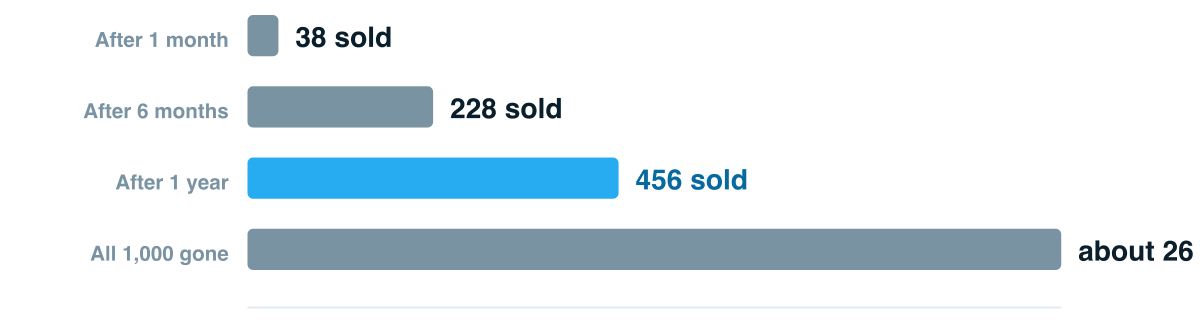
Cards do not convert to money on the day you buy them. In our store 2.9% of listed cards sell per month. A thousand card collection takes something like 34 months to clear one card at a time.
A buyer paying you today is paying cash now for money that arrives over three years, minus fees, minus the hours spent scanning, listing and packing every one of those cards.
That is the honest reason the number is not 100%. Not greed, float and labour.
So what is a fair offer for your situation
| What you have | Reasonable range | Why |
|---|---|---|
| Graded cards, PSA 9 or 10 | 80% to 90% | Liquid, easy to price, sells fast |
| Modern chase cards, sealed product | 70% to 80% | Clear market price, real demand |
| Vintage holos in good shape | 60% to 75% | Valuable but condition disputes are common |
| A binder of mixed playables | 50% to 65% | Every card has to be looked up one by one |
| Unsorted bulk commons | 1 to 10 cents a card | Percentage of market value stops meaning anything |
Two things move an offer up inside those ranges. Sorting, because you are doing work the buyer would otherwise pay for, and honesty about condition, because a buyer who trusts your description does not need to price in surprises.
How to check an offer in ten minutes
Pick the five most valuable cards you think you have. Look each one up in eBay sold listings, not active ones. Add those five up.
If the offer for the whole collection is less than the sold value of those five cards, something is wrong, and you should ask the buyer to walk you through their number. Any buyer worth dealing with will do it.
If you cannot identify your best cards yet, start with what your old cards are worth, and if fakes are a worry, here is how to spot them.
When a low offer is still the right answer
If the alternative is three years of listing cards yourself for $2.25 a sale, a fair one time price is worth real money in convenience. We compared both routes with the same numbers.
Ask for the reasoning. A buyer who cannot explain their offer is telling you something.
Frequently asked questions
- What percentage of market value should I get for my Pokémon collection?
Between 50% and 75% is typical for a collection with real cards in it. Graded cards can reach 80% to 90% because they are liquid. Unsorted bulk is not priced as a percentage at all, it goes by the card, roughly 1 to 10 cents.
- Is 40% of market value a fair offer?
It is low for a collection with identifiable cards, and worth questioning. It can be reasonable if the collection is mostly unsorted commons, where percentage of market value stops being a meaningful measure.
- Why do buyers not pay full market value?
Because market value is what a card eventually sells for, not what it is worth today. In our store fees take 21.5%, shipping takes about 30.8% of an average sale, and only 2.9% of listed cards sell per month, so a buyer is advancing cash for money that arrives over years.
- How can I check an offer quickly?
Look up your five best cards on eBay sold listings and add them up. If the offer for the whole collection is below that total, ask the buyer to explain their number.