
The short answer
Look up their five best cards on eBay sold listings before talking to anyone. That single step prevents almost every bad deal, because the usual way a kid gets taken advantage of is a trade where nobody checked a price.
Expect most of the binder to be worth cents. Expect the value to sit in a handful of shiny cards. And bring your kid along when you sell, because it is the part they remember.
Kids trade cards with other kids, and card shops buy from whoever walks in. Neither is a scam by default. What causes bad outcomes is that one side knows the prices and the other does not.
The five minute version
Sit down together and pull out every shiny card and everything with ex, GX, V or VMAX after the name. That is the value pile. The rest is bulk, and there is nothing sad about that.
Search each card from the value pile on eBay by name and number, then filter to Sold items. Active listings are wishes. Sold is what a real person paid last week.
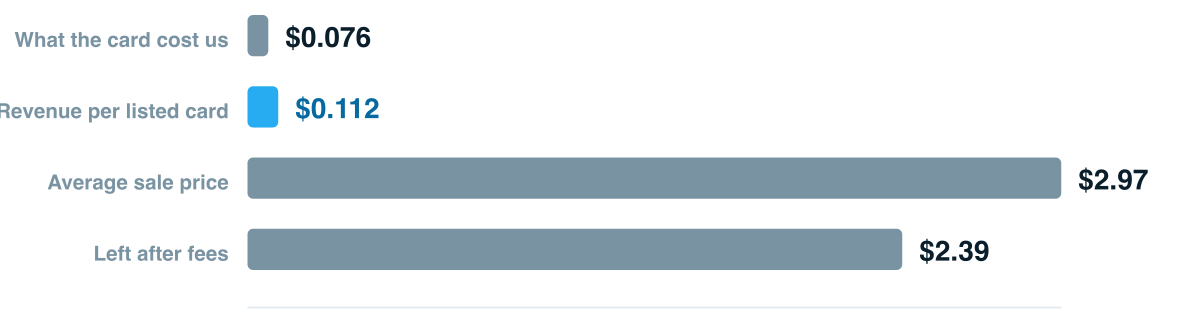
Set expectations with this chart before you look anything up. In our store, 61% of everything we sold went at the $1.99 floor. A binder of 400 cards is not a college fund, and it helps if everyone knows that going in.
What a fair price looks like
Any buyer, shop or individual, has to cover fees of about 21.5%, shipping, and the time to sell each card. That is why offers land between 50% and 75% of market value on real cards, and at cents per card on commons.
A shop offering 60% of sold value on the good cards is being reasonable. A shop offering $20 for a binder that contains a $90 card is not, and now you can tell the difference.
Three things worth teaching while you do it
Condition is most of the price. The same card can lose half its value from one soft corner. Our condition guide is a good five minute lesson.
Fakes are everywhere. If a card came from a schoolyard trade or a marketplace lot, check it. The light test and the texture test catch most of them.
Never trade on hype alone. Prices move, and the card everyone wants this month is not always worth more than the quiet one.
Where to sell
For a handful of good cards, list them yourself and let your kid write the description. For the rest, a single lot sale is worth the small discount, because the alternative is months of mailing envelopes.
Whatever you get, let them see the numbers. A kid who learns that the shiny one was worth $40 and the other 380 were worth $12 has learned something more durable than the $52.
Frequently asked questions
- How do I know if my child's Pokémon cards are worth anything?
Pull out every shiny card and anything marked ex, GX, V or VMAX, then look those up on eBay sold listings by name and card number. The rest is bulk and is priced by the pile rather than by the card.
- Is it safe to sell my kid's cards to a local shop?
Usually yes, as long as you know the prices first. A shop covering fees of around 21.5%, shipping and the time to sell will offer somewhere between 50% and 75% of market value on the good cards. Ask them to explain the number.
- How much is a binder of Pokémon cards worth?
Less than most people expect. In our store 61% of everything sold went at the $1.99 minimum and the average sale was $2.86. A 400 card binder usually has its value in five or six cards.
- Should my child be there when we sell?
It helps. They learn what condition does to price and what their cards are really worth, which is worth more than the money in the long run.