
The short answer
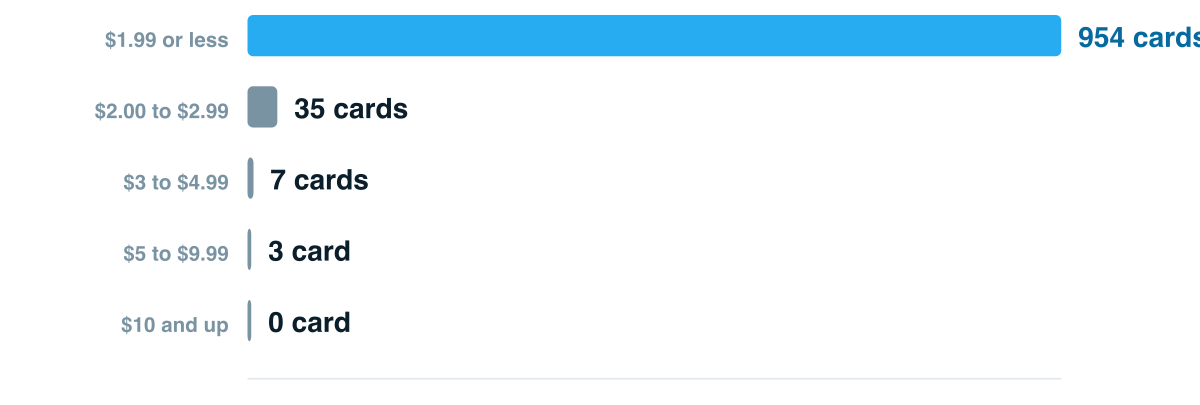
Out of 1,000 modern bulk cards, in our own scanned inventory: 975 are worth the $1.99 minimum, 19 fall between $2 and $3, and only 5 clear $3. One card in a thousand passes $10.
By finish it is mostly reverse holos. That is the whole distribution, and it is why bulk is priced by the pound and not by the card.
Everyone selling bulk shows you the one good card they pulled. Here is the full contents of a lot instead, from 3,299 cards we scanned, identified and priced one by one.
The price distribution nobody publishes
97.5% of our inventory prices at the $1.99 floor. Not because the cards are worthless, but because below two dollars a single is not worth listing on its own, so the floor is where they all pile up.
The interesting part is the tail. Five cards in a thousand clear $3. One clears $10. Our best card in 3,299 was priced at $129.99, and that is one card, once.
What it looks like by finish
Modern bulk is mostly reverse holos, which is good news for a buyer: reverse holos hold the floor better than non foil commons and they sell faster in our data, at an average of 5.7 days.
Non foil commons are the filler. They sell, they just sell at the bottom and slowly.
So what is 1,000 cards actually worth
At our prices a thousand card lot costs about $76.00 and produced roughly $82.94 of sales in the first month, $65.11 after fees.
The full value takes years to extract, because only 2.9% of listed cards sell per month. A bulk lot is a slow annuity, not a payday.
What this means if you are buying
Price the lot on the floor, not on the tail. A thousand cards at the floor is the reliable part of the value, and anything above it is a bonus you cannot count on before you have scanned the box.
It also means volume is the only lever that works. One lot of a thousand contains about five cards worth listing individually, so a business built on this needs thousands of cards moving, not hundreds.
How the era changes the mix
Bulk from the last three years carries more reverse holos and more filler energy cards, because modern sets print both heavily. Bulk from 2010 to 2016 has fewer reverse holos but the ones it has are harder to find, so they hold price better.
Anything pre 2003 stops being bulk in the normal sense. At that age condition alone decides the price and a common in clean shape can be worth more than a modern holo, which is why vintage lots are priced per card and not per pound.
Two limits on these numbers
This is our pricing, and we use a $1.99 floor, so every card that would price below that shows up at $1.99. The real spread at the bottom is wider and lower than the chart suggests.
And this is one buying source, modern era, English. A vintage lot or a Japanese lot behaves completely differently.
What it does tell you reliably is the shape: a tiny number of good cards, an enormous floor, and nothing much in between. Plan around that shape and bulk makes sense. Plan around the hit and it does not.
Frequently asked questions
- How many valuable cards are in 1,000 bulk cards?
In our inventory, about 5 cards per 1,000 price above $3 and one above $10. 975 of every 1,000 sit at the $1.99 floor.
- What is the average value of a bulk Pokémon card?
Our average sale price was $2.86, but 61% of sales happened at the $1.99 minimum, so the average is pulled up by a small number of better cards rather than being typical.
- What finishes are in modern bulk?
Mostly reverse holofoils, then regular holos, then non foil commons. Reverse holos hold a price floor that non foil commons do not, which is why they are worth more per card.
- Is bulk worth buying if most cards are worth $1.99?
It can be, because the floor multiplied by volume is the business. A 1,000 card lot costs about $76.00 at our purchase price and produced $82.94 of sales in the first month alone.
A thousand cards is the point where photographing them one at a time stops being viable. Which machine handles that volume is in the best scanner for trading cards.