
The short answer
Unsorted modern bulk runs about 1 to 10 cents a card. We paid $0.08 for our last lot of 1,750. Sorted reverse holo or holo bulk costs more, usually 5 to 25 cents, because someone already did the work.
Anything above about 15 cents a card for unsorted commons is a bad deal, and you can prove it with the numbers further down.
Bulk is the only part of this hobby priced like a commodity, so the price only makes sense next to what is inside. Let's do both.
What the going rates look like
| What you are buying | Typical price per card | What you are paying for |
|---|---|---|
| Unsorted modern commons | 1 to 5 cents | Volume. Nobody has looked at these |
| Unsorted mixed with energy removed | 3 to 8 cents | Slightly less filler |
| Sorted reverse holo bulk | 5 to 15 cents | The sorting work, and a real price floor |
| Sorted holo and rare bulk | 15 to 50 cents | Cards that can be listed individually |
| Vintage bulk, pre 2003 | 20 cents and up | Age, and the chance of a real hit |
We paid $0.08 a card for unsorted modern, which sits at the low end because we buy in quantity and do our own sorting.
Why the ceiling is where it is
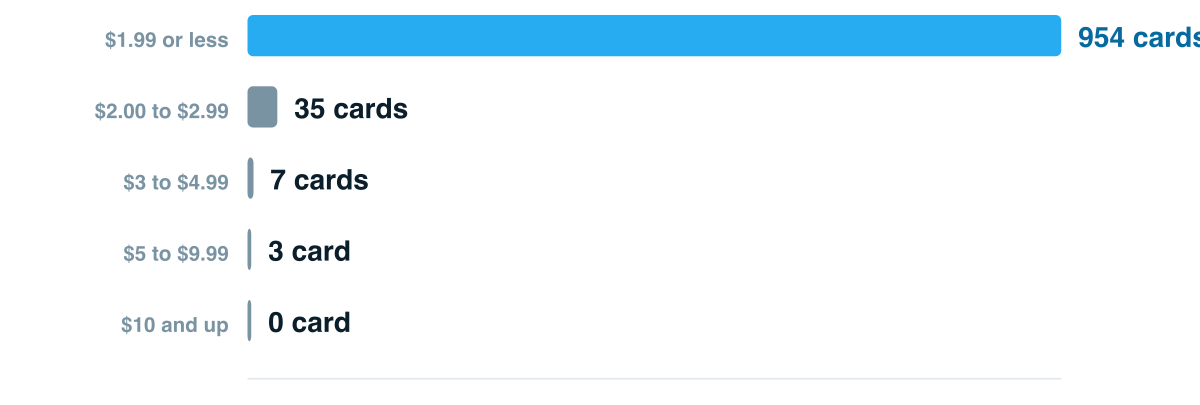
Here is the honest picture of a modern bulk lot. Out of every 1,000 cards we scan and price, 975 end up at our $1.99 floor and only 5 clear $3.
So the value of a bulk lot is not in the hits. It is in the floor, multiplied by volume, minus everything it costs to reach a buyer.
Work backwards from what a card returns
A $1.99 card returns about $1.42 after eBay takes its cut, and the shipping label averages $0.88. Call it a dollar of margin per card sold, before supplies.
But only 2.9% of listed cards sell per month, so that dollar arrives slowly. Pay 10 cents a card and you need to sell one card in ten just to break even on the purchase, which happens, but takes months.
Where the lots actually come from
Three sources, and they price differently. Collection buyouts are the freshest, because the seller usually pulled two cards they recognised and left everything else. Shop bulk has been through a counter, so the obvious value is gone but the volume is reliable. Bulk sold as bulk online is the most picked, and should be the cheapest.
We buy the first kind when we can and the second when we cannot, which is how we land at $0.08 a card. If an online lot is priced like a fresh collection, that is the signal to walk.
The two questions to ask any bulk seller
Has it been picked? Every lot that changed hands has been looked at by somebody. Ask what came out. A seller who says nothing came out is either new or not being straight.
What era is it? A lot from 2016 and a lot from last year have completely different mixes. Newer bulk has more reverse holos, which is good, and more filler energy, which is not.
For the whole arithmetic of turning that lot into money, see whether buying bulk to sell singles actually pays and what eBay keeps from each sale.
Buy on the mix, not on the dream. The Charizard is not in there, and the seller already looked.
Frequently asked questions
- How much does Pokémon bulk cost per card?
Unsorted modern bulk runs about 1 to 10 cents a card. We paid $0.08 a card for our last lot of 1,750. Sorted reverse holo bulk costs 5 to 15 cents and sorted holo bulk 15 to 50 cents.
- Is 10 cents a card too much for bulk?
For unsorted modern commons, yes in most cases. In our inventory 975 of every 1,000 cards price at the $1.99 floor and only 5 clear $3, so at 10 cents you need to sell one card in ten just to recover the purchase.
- What is the difference between sorted and unsorted bulk?
Unsorted is exactly as it came out of packs or collections. Sorted has been separated by finish or rarity, which means someone already did three to five hours of work per thousand cards, and that is what the higher price pays for.
- How can I tell if a bulk lot has been picked over?
Ask the seller directly what came out of it, and check the ratio of reverse holos to commons. Every lot that has changed hands has been looked at by someone; a seller who claims otherwise is either new or not being straight.