
The short answer
Reverse holo bulk is the best part of a modern lot. It trades at roughly 5 to 15 cents a card sorted, and in our store reverse holos sell faster than regular holos, at an average of 5.7 days.
They still mostly sell at the floor. The advantage is that they hold that floor, where non foil commons fall below it.
A reverse holo is a normal card with the shine applied to the card body instead of the artwork. Every pack has one, which is why there are so many, and why they end up as their own category of bulk.
Why buyers pay more for it
Two reasons, and only one of them is about money. Reverse holos are listable: they clear the $1.99 floor reliably, so a lot of them converts into inventory rather than filler.
The second is speed. In our sales data they moved in 5.7 days on average, faster than holos at 9.3, which we did not expect and wrote up in full.
What it is actually worth
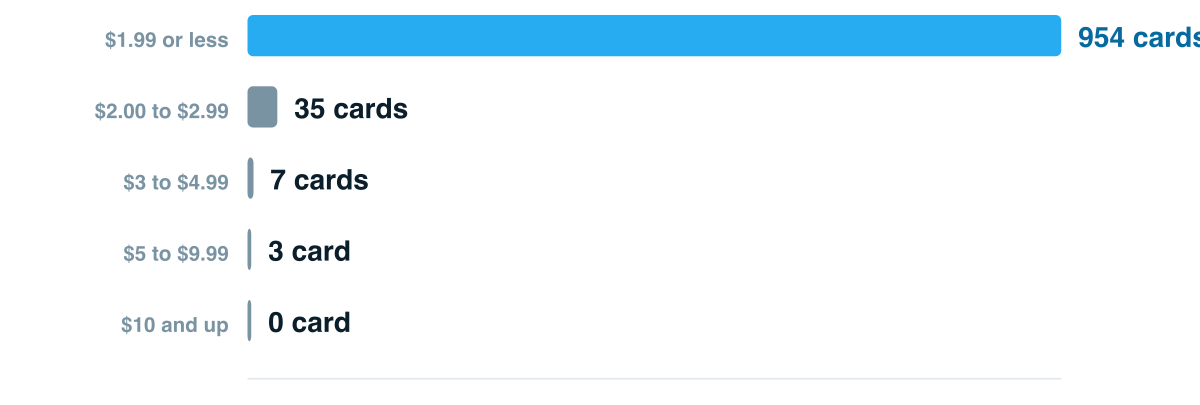
Do not overpay on the strength of the finish. Our inventory is 68% reverse holo and it still prices 97.5% of cards at $1.99.
A reverse holo of a common Pokémon from a recent set is a floor card. A reverse holo of a popular Pokémon from a set people chase is not. The finish sets the floor, the name sets the ceiling.
Why the finish exists at all
Reverse holos were introduced so that every pack would contain something shiny, which is exactly why they are common and exactly why they are useful. A guaranteed slot means guaranteed supply, and guaranteed supply is what makes a bulk category possible.
For a buyer that is the whole point. You are not hunting rarity here, you are buying a predictable mix at a predictable price, and the reverse holo is the most predictable thing in the box.
Which reverse holos are worth more than the floor
Three things lift a reverse above $1.99. A popular Pokémon, meaning the twenty names everyone knows. A set people still open, because demand follows attention. And a card that sees play, since trainers and stadiums from a competitive set get bought in fours.
Everything else is floor inventory, and that is fine: floor inventory multiplied by volume is the whole model. Just do not pay a premium for a reverse holo of a Pokémon nobody searches for.
The one trap
Reverse holos are the finish most often miscatalogued, in shops and in software. We have had to correct dozens of our own, because a reverse holo listed as a normal card sells for the wrong price and cannot be found by the people looking for it.
If you are buying a sorted reverse lot, spot check twenty cards against the set list before you trust the label. Our guide to telling the two apart covers what to look at.
Pay for reverse holo bulk when the price is close to unsorted. It is the same cards with the filler removed, which is exactly what you want, right up until you pay holo prices for it.
Frequently asked questions
- How much is reverse holo bulk worth?
Sorted reverse holo bulk trades at roughly 5 to 15 cents a card, above unsorted commons because reverse holos reliably clear a $1.99 listing floor where non foil commons fall below it.
- Do reverse holos sell faster than holos?
In our data yes. Reverse holofoils sold in 5.7 days on average against 9.3 for regular holos, which surprised us. Supply and price point are the likely explanation.
- Are reverse holos rare?
No. Modern packs include one, so they are the most common finish in modern bulk. Their value comes from the price floor they hold, not from scarcity.
- What is the most common mistake with reverse holos?
Cataloguing them as normal cards. A reverse holo listed as a regular card is priced wrong and cannot be found by buyers searching for the reverse, and it is the error we have had to correct most often in our own inventory.