
The short answer
You do not go to the post office every day. Print labels at home, pack in one sitting, and drop everything in a blue box or hand it to the carrier on a schedule you choose: most one person stores do this three times a week.
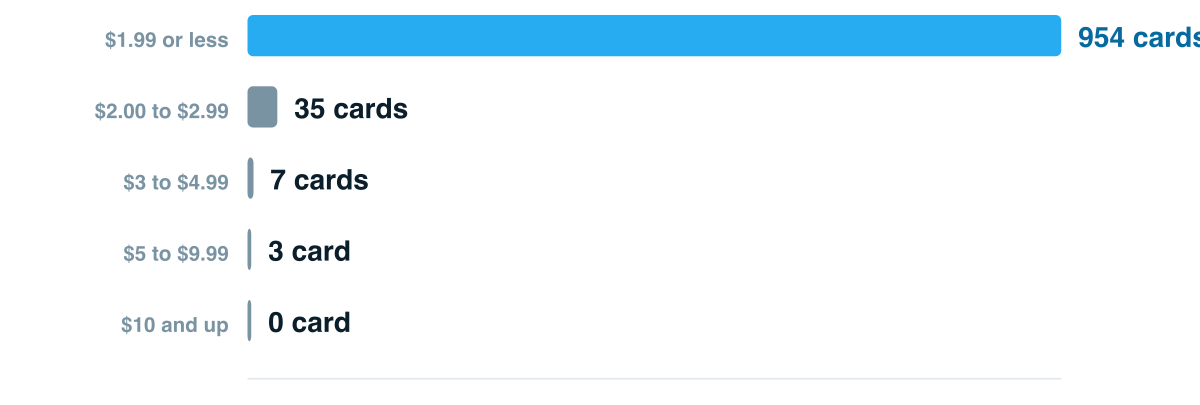
Our labels average $0.88 using eBay Standard Envelope, across 50 packages. The routine matters more than the materials.
Shipping is the part that worries every new seller and the part that turns out to be a solved problem. What follows is the whole routine of a store with one person in it.
The daily part takes ten minutes
Orders come in overnight. In the morning you print the labels, because a label bought online is cheaper than one bought at the counter and it means you never queue.
Then the cards get pulled from wherever they live. This is the step that is slow if your storage is disorganised and instant if every card has an address, which is the entire reason we number our storage rather than sorting alphabetically.
The packing, per card
| Layer | What it is for |
|---|---|
| Penny sleeve | Stops surface scratches |
| Toploader or semi rigid | Stops bending, which is what actually destroys cards |
| Team bag or tape over the top | Stops the card sliding out in transit |
| Envelope or mailer | The postal layer, chosen by value |
Under about $20 the eBay Standard Envelope is the cheapest tracked option and it is what most of our orders use. Above that, a bubble mailer with a rigid backing, and above a few hundred dollars, signature confirmation.
We compared the options in envelope versus mailer and the mailers we actually use.
The trip to the post office
Three times a week is enough for most volumes, and buyers do not notice the difference between same day and next day dispatch nearly as much as sellers think. What they notice is tracking that updates.
If you print labels, you can drop packages in any collection box or schedule a free pickup, which removes the trip entirely on the days you do not want to make it.
The address question
Do not print your home address on a few hundred envelopes. A PO box or a virtual business address costs little per month and keeps your home off every package you send, which matters more once you are shipping regularly and the return address is on all of it.
What to do when something goes missing
Little gets lost, but it happens. With tracking, the answer is to refund as soon as the trail has been stalled for a week, without waiting for the buyer to chase you.
It costs the price of a cheap card and it buys a bad review that never gets written. Arguing about a two dollar shipment costs more time than the shipment was worth.
The small things that pay for themselves
A thank you card at 2.5 by 3.5 inches fits the same sleeve as a card and costs a few cents printed in bulk. It is the cheapest thing in the box and it is what people photograph.
Branded envelopes are the opposite: they cost real money, they slow down restocking, and no buyer has ever left better feedback because of one. Spend on the card that goes inside, not the paper it travels in.
The whole thing takes an hour a week once it is a routine. It is the part of the business that stops being interesting fastest, which is exactly why it should be the most systematic.
Frequently asked questions
- Do I have to ship Pokémon cards every day?
No. Most one person stores print labels at home and drop off three times a week. Buyers notice tracking that updates far more than they notice same day dispatch.
- What is the cheapest way to ship a single card?
Under about $20 in value, eBay Standard Envelope with tracking. Our labels average $0.88 across 50 packages.
- How should a single card be packed?
Penny sleeve, then a toploader or semi rigid, then something to stop it sliding out, then the envelope. Bending is what destroys cards in transit, not scratching.
- Should I use a PO box?
Worth it once you ship regularly. Your return address goes on every package, and a PO box or virtual address keeps your home off all of them for a few dollars a month.