
The short answer
Do not price against the cheapest listing. Price against the median of the three cheapest, because the single lowest listing is nearly always broken: a lot, a proxy, a damaged card or a Japanese print that slipped into the search.
Anchoring to that one listing gives away margin on every other card you own, and it starts a race that the seller with the most capital wins.
This is the rule we run in code across the whole catalogue, and it is the one pricing decision that changed our numbers most.
Why the cheapest listing lies
Search any common card and look at the bottom of the results. One of these is usually true: it is a bundle priced as a single, it is the wrong card with the right name, it is heavily played and not described as such, or it is a different language edition.
None of those are your competition. They are noise, and matching them means selling a clean near mint card at damaged card prices.
The median of the three cheapest survives all four cases, because a broken listing rarely comes in threes.
The rule, in full
| Situation | What we do |
|---|---|
| Three or more comparable listings | Take the median of the three cheapest |
| Market price far above that floor | Keep the floor, note the gap; the floor is probably damaged copies |
| Market price far below the floor | Trust the sold data, not the asking prices |
| Fewer than three listings | Use the catalogue market price and review by hand |
| Our current price is already higher | Leave it. The check raises prices, it never lowers them |
That last row matters more than the rest. A price check that can only raise prices is safe to run unattended; one that can lower them will quietly walk your whole catalogue down every time a competitor liquidates.
The condition inversion
Sometimes a near mint copy lists below a lightly played one. It looks like an error and it is not always: a seller with volume prices to move, and a seller with one card prices on hope.
When we hit that, we take the higher of the two as the reference rather than assuming the near mint listing is correct. The alternative is pricing a good card below a worse one, which is the same as leaving money on the table twice.
What it is worth in practice
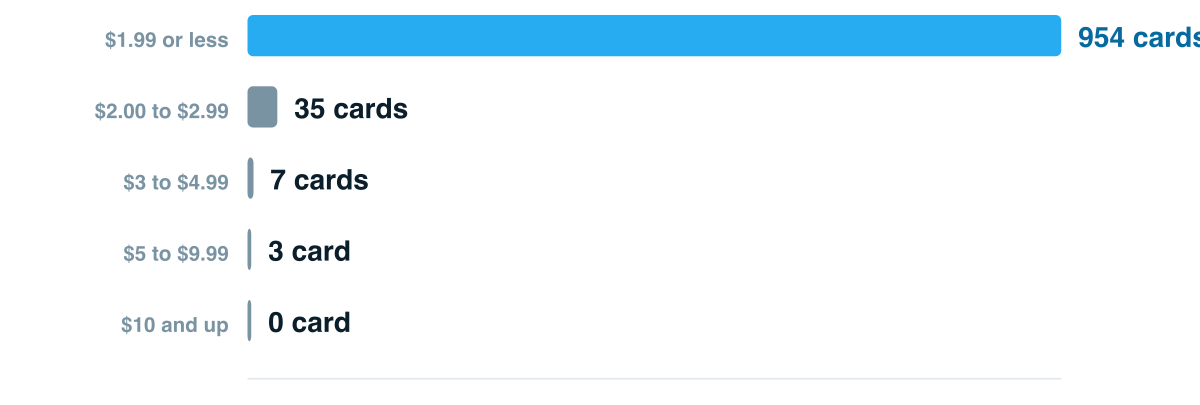
Most of a bulk catalogue sits at the price floor and cannot move. The cards that can move are the minority, and on those, the difference between the lowest listing and the third lowest is often twenty or thirty percent.
On a $2 card that is nothing. Across the few hundred cards in a catalogue that clear the floor, it is the difference between a month that pays and one that does not. See also how we price bulk and what fees leave you.
How often to run it
Monthly is enough for a bulk catalogue. Floor card prices do not move, and the few cards that can move do not change week to week by enough to justify looking more often.
The exception is the month after a major release, when prices across previous sets readjust and an extra pass is worth the time.
The one thing to automate carefully
Run the check often, let it raise, and make lowering a manual decision with a flag you have to type. Pricing software that adjusts in both directions unattended is how sellers end up racing each other to the bottom of a market neither of them wanted to move.
Frequently asked questions
- Should I price my cards at the lowest listing?
No. The single cheapest listing is usually a bundle, a mislabelled card, a damaged copy or another language edition. Use the median of the three cheapest, which survives all four.
- What if the market price is far above the cheapest listings?
Keep the floor and note the gap. A floor far below market usually means the cheap copies are damaged or from another region, not that the card is worth less.
- Should pricing software lower prices automatically?
No. Let it raise prices unattended and make lowering a manual decision. Automatic lowering walks your catalogue down every time a competitor liquidates.
- What if a near mint copy lists below a played one?
Take the higher of the two as your reference. Pricing a good card below a worse one leaves money on the table twice.