
The short answer
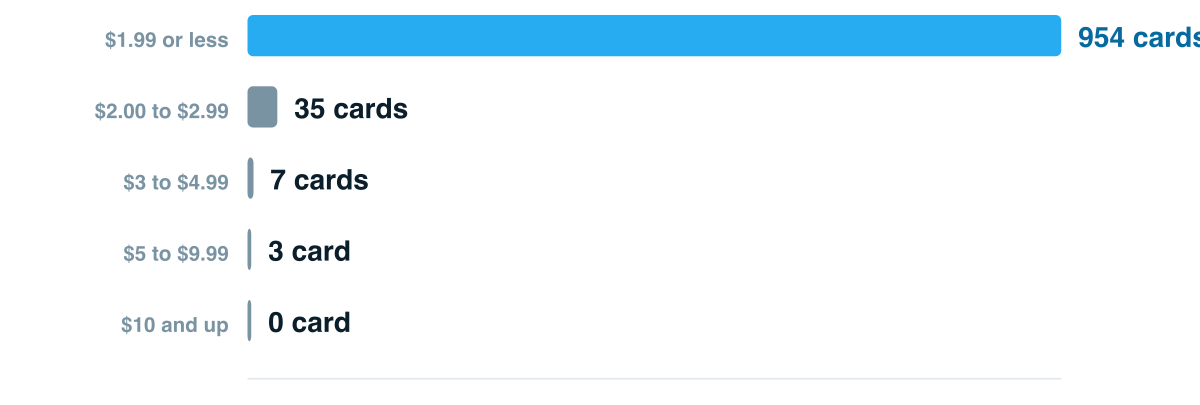
No, not as an investment. Bulk is inventory for a small business, not an asset that appreciates. It pays through work: buying at $0.08 a card, listing thousands of them, and collecting about $2.25 per sale over years.
If you want cards that go up in value while sitting in a box, bulk is the wrong end of the hobby entirely.
The question comes up because bulk is cheap and Pokémon prices make headlines. Those two facts are unrelated, and here is why.
What an investment needs, and bulk lacks
An asset appreciates on its own. Bulk does not: a box of commons bought today is worth roughly the same box of commons in three years, minus the sets that rotated further out of relevance.
What changes the value is work. Sorting, identifying, photographing, listing and shipping. Take the work away and there is no return, which by definition makes it a job rather than an investment.
The returns, measured
Our thousand card unit cost about $76.00 and returned $82.94 gross in month one. That looks like a spectacular return until you add the hours, the fees and the 34 months it takes to sell the rest.
Spread properly, this is a modest hourly wage with inventory risk attached. A good small business, a poor investment.
What does appreciate
Sealed product, graded high grade vintage, and specific chase cards with real scarcity. Those move on demand and supply rather than on your labour, which is the actual definition people are reaching for.
They also require capital, patience and the risk of being wrong about which card matters in five years. Bulk requires none of that and rewards none of it.
Where the appreciation story comes from
The idea that bulk appreciates comes from a real thing happening to a different product. Vintage commons from 1999 genuinely are worth more than they were, because time removed most of them from circulation and the survivors are in worse condition every year.
Modern bulk will not repeat that. Print runs are vastly larger, sleeves and binders are normal now, and the cards being bought today are being preserved rather than destroyed. Scarcity is what did the work, and modern sets are not scarce.
The risk nobody mentions
Bulk does have a downside, and it is not price. It is obsolescence: a set that rotates out of competitive play loses the small demand that kept its commons moving, and a lot bought at the wrong moment gets slower every month.
That risk is manageable because the money is small, but it is real, and it is the opposite of how an investment is supposed to behave.
When bulk is the right choice anyway
When you want a business that starts with a few hundred dollars, teaches you the market fast, and produces cash from month one rather than an exit in year five.
That is genuinely valuable, and it is what our own first month and the wider playbook are about. Just do not confuse it with the cards going up.
Buy bulk to work it. Buy sealed to hold it. Mixing those two up is how people end up with a garage full of commons and a story about the market being down.
Frequently asked questions
- Is Pokémon bulk a good investment?
No, not in the sense of an asset that appreciates. A box of commons is worth roughly the same in three years. What produces the return is the work of sorting, listing and shipping.
- How much does bulk actually return?
Our 1,000 card unit cost about $76.00 and produced $82.94 of gross sales in month one, $65.11 after fees, with the rest selling out over roughly 34 months.
- What Pokémon products do appreciate?
Sealed product, high grade vintage and genuinely scarce chase cards. Those move on supply and demand rather than on your labour.
- Is bulk a good way to start a card business?
Yes. It needs little capital, teaches the market quickly and produces cash from the first month. That is a different claim from being an investment.