
The short answer
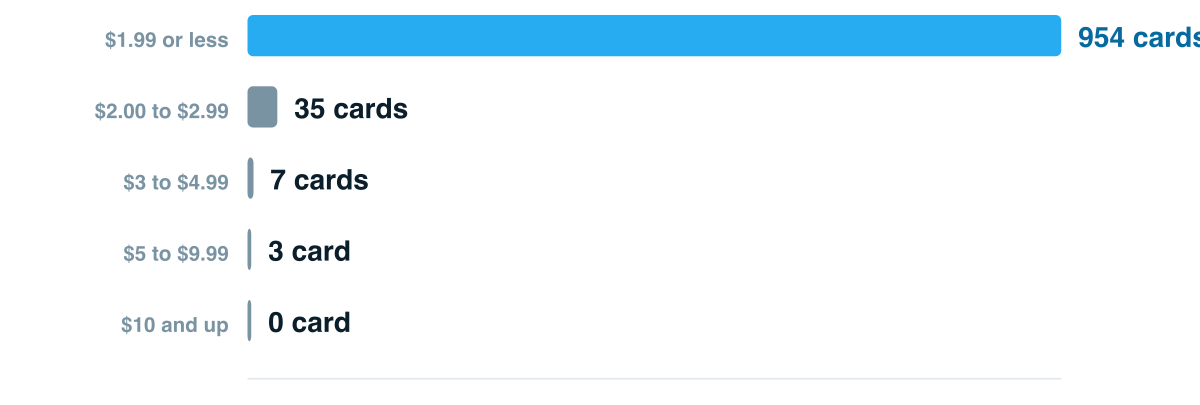
No, bulk does not have to be near mint, and insisting on it is how you overpay. Played modern bulk sells at the same $1.99 floor as near mint modern bulk, because 97.5% of cards are floor cards where condition does not change the price.
What matters is that the condition is described. A lot sold as near mint that arrives played is a return; the same lot sold as played is a normal purchase.
People ask this because every marketplace listing screams near mint, and it makes the played lots look like a compromise. For bulk specifically, they are not.
Why condition barely moves modern bulk
A modern common in near mint and the same card lightly played both list at the floor, because the floor is set by what it costs to sell a card at all rather than by the card's condition.
So paying a premium for near mint modern commons buys you nothing on resale. The premium only starts to matter above about $10, and there are five of those cards in every thousand.
Where it does matter
| Type of lot | Does condition change the price? |
|---|---|
| Modern commons and reverse holos | Barely. Both end at the floor |
| Modern holos and chase cards | Yes, above about $10 |
| Vintage, pre 2003 | Yes, a lot. It is most of the price |
| Graded cards | It is the entire product |
The Sun and Moon or XY era lot someone is offering you as not near mint is, in resale terms, close to identical to a near mint one. We wrote the full version of this in whether damaged cards are worth anything.
What the seller means by the grade
Condition language is not standardised between sellers, and one person's lightly played is another's near mint. The word matters far less than a photo of the actual cards.
When someone says the lot is not near mint, that is usually an honest seller describing a normal box. When someone says every card is near mint on a thousand card lot, that is a claim nobody can verify and few can deliver.
The two exceptions worth checking
Creases and water damage are different from wear. A creased card is not lightly played, it is unsellable individually, and a lot with a lot of creasing is genuinely worth less even at the floor because part of it cannot be listed at all.
Whitening on reverse holos shows more than on regular cards, because the foil surface cracks along an edge and the eye catches it. It still sells, it just photographs badly.
How to buy a played lot properly
Ask for a photo of a random handful, face down. The backs tell you the truth about edge wear faster than the fronts, which is the same reason we scan both sides of everything we sell.
Then price it as bulk, because that is what it is. Our own unsorted rate is $0.08 a card and we do not pay more for a near mint claim on modern commons.
The one thing to insist on
An honest description. Not near mint, just accurate. A seller who says lightly played to moderately played with some heavier ones near the bottom is giving you everything you need to price it, and that seller is worth going back to.
The one to avoid is the lot described as near mint at a near mint price, because you are paying for a grade that does not survive the first look.
Frequently asked questions
- Does bulk have to be near mint?
No. In modern bulk a near mint common and a lightly played one both list at the price floor, and 97.5% of our inventory prices there. Paying a near mint premium on modern commons buys nothing back.
- When does condition change a bulk price?
Above about $10 on modern cards, and throughout on vintage, where condition is most of the price. On graded cards it is the entire product.
- What condition problems actually reduce value?
Creases and water damage, because a creased card cannot be listed individually at all. Ordinary edge wear on floor cards changes almost nothing.
- How do I check a played lot before buying?
Ask for a photo of a random handful face down. Backs show edge wear faster than fronts, which is the same reason sellers should scan both sides.